
Sheaffer Pen Company 1940 to 1963
Sheaffer Pen Company 1940 to 1963
Craig Sheaffer Takes Over
Craig Royal Sheaffer succeeded his father, Walter A. Sheaffer as President of the Sheaffer empire in 1938 when his father moved on to become Chairman of the Board. However, it was not really a succession as we know it, as the forty-one year old Craig had been in the company since the days the first pens were made in his father’s jewelry store’s backroom. He was as old a hand as any. Craig had been there, done it all, and as was much an originator as the inheritor of the Company. There is little wonder that there was hardly a ripple as the change was ushered in. In fact, Sheaffer emerged stronger with Walter’s vision now being supplemented with the raw energy of Craig’s youth.
But this was not the best of times for the nation as a whole, as the air was becoming increasingly toxic with the smell of destruction. While the epicenter of WWII was in Europe, it was slowly engulfing the world and it was evident that the United States would soon be drawn in. As a matter of fact, only a few years after Craig moved into his new role, the Japanese bombed Pearl Harbor. The date, of course, was December 7th, 1941.
The War Years
From that day until September 2, 1945 (the date marking the end of the hostilities), the Sheaffer story is one of single-minded devotion to national duty as all hands were called on to contribute to the war effort. The company soon received their first order for communications plugs for the Army Signal Corps and eventually produced seven million units. The "auto-tune" device that Sheaffer manufactured incorporated 1000 separate parts in a set. Considering that they were to be used in high-flying bombers, each had to be not only fail-proof, but pass severe certification tests. Sheaffer also produced telephone plugs and over 1,000,000 bomb and artillery fuses.
[caption id="attachment_4831" align="aligncenter" width="648"] Sheaffer produced over 1,000,000 bomb fuses. Shown here, from the Sheaffer Museum, is the 1,000,000th fuse. Source: Midwest Wanderer[/caption]
The Sheaffer team, increasingly women as most of the men were in the service, not only lived up to the challenge, but were able to automate a large part of the production, scaling up efficiencies. This led to the presentation of the Army Navy "E Award" for "Excellence" to the company in 1944. During the course of the war, 80% of the auto-tuners that were pressed into service were from Sheaffer factories!
[caption id="attachment_4840" align="aligncenter" width="890"]
Sheaffer produced over 1,000,000 bomb fuses. Shown here, from the Sheaffer Museum, is the 1,000,000th fuse. Source: Midwest Wanderer[/caption]
The Sheaffer team, increasingly women as most of the men were in the service, not only lived up to the challenge, but were able to automate a large part of the production, scaling up efficiencies. This led to the presentation of the Army Navy "E Award" for "Excellence" to the company in 1944. During the course of the war, 80% of the auto-tuners that were pressed into service were from Sheaffer factories!
[caption id="attachment_4840" align="aligncenter" width="890"] The Company and its employees were awarded the Army-Navy "E" Award during ceremonies in Fort Madison, IA in 1944. Walter is second from left. Craig is far right. Source: Sheaffer's Review, September 1963.[/caption]
Naturally, production of writing instruments had come to a virtual standstill and the limited numbers that were produced went to the armed services. By 1944, as many as four hundred and ninety Sheaffer employees were called in for active duties and there were four gold stars in their rooster of names.
The Company and its employees were awarded the Army-Navy "E" Award during ceremonies in Fort Madison, IA in 1944. Walter is second from left. Craig is far right. Source: Sheaffer's Review, September 1963.[/caption]
Naturally, production of writing instruments had come to a virtual standstill and the limited numbers that were produced went to the armed services. By 1944, as many as four hundred and ninety Sheaffer employees were called in for active duties and there were four gold stars in their rooster of names.
Sheaffer produced over 1,000,000 bomb fuses. Shown here, from the Sheaffer Museum, is the 1,000,000th fuse. Source: Midwest Wanderer[/caption]
The Sheaffer team, increasingly women as most of the men were in the service, not only lived up to the challenge, but were able to automate a large part of the production, scaling up efficiencies. This led to the presentation of the Army Navy "E Award" for "Excellence" to the company in 1944. During the course of the war, 80% of the auto-tuners that were pressed into service were from Sheaffer factories!
[caption id="attachment_4840" align="aligncenter" width="890"] The Company and its employees were awarded the Army-Navy "E" Award during ceremonies in Fort Madison, IA in 1944. Walter is second from left. Craig is far right. Source: Sheaffer's Review, September 1963.[/caption]
Naturally, production of writing instruments had come to a virtual standstill and the limited numbers that were produced went to the armed services. By 1944, as many as four hundred and ninety Sheaffer employees were called in for active duties and there were four gold stars in their rooster of names.
A new Plant in 1942
A new plant was pressed into the service in 1942. Its parking lot was converted into a giant bicycle stand to aid the process of rationing of gas. The soup and hot coffee served by Sheaffer's War Division was so well accepted that many believe it was the precursor of the cafeteria! But even during the war, Sheaffer remained waveringly committed to its employees. As an example, the profit-sharing system instituted by Walter was now expanded by Craig to include a trust fund (or retirement) program. The year was 1942.
The Post-War Years
The end of the war was marked by explosive movements in all directions as Craig Sheaffer personally led the activities. Products were at various stages of development when the war had broken out, expansion programs had been put on hold, merchandising and sales pitches curtailed, induction of new plant and machinery had been put on hold. All these were now simultaneously pursued as Sheaffer prepared for the post-war era. While war induced shortages were still in place and material costs were on an upward spiral, in 1947 Craig held to pre-war prices in almost every product line. This helped Sheaffer to quickly overcome the wartime aberration and regain its position in the top of it's field.
New Products and The Ballpen
The introduction of new writing instruments, perhaps the most significant being the "Touchdown-filler" and the "Touchdown-Vacuum filler," and the adoption of new manufacturing techniques led to significant cuts in both production time and quality concerns. Bottom-line profits increased which in turn helped offset the rise in input costs. Overall, the period immediately following the war was one of optimism about the future, laced with a belligerence that characterize the victors. And it was perhaps this optimism that blinded the fountain pen industry from a threat that was looming in the horizons – storm clouds, in the form of ball point pens.
[caption id="attachment_4832" align="aligncenter" width="600"] Touchdown Filler. Source: Pen Hero[/caption]
Touchdown Filler. Source: Pen Hero[/caption]
[caption id="attachment_4833" align="aligncenter" width="566"] Vacuum-fill Instructions. Source: paperwantsapen[/caption]
Vacuum-fill Instructions. Source: paperwantsapen[/caption]
Enter the Stratowriter
While the ball pen, with its built in ink and fuss-free performance was another one of the war’s children, the fountain pen industry cannot be faulted for not taking it very seriously. At this time the ballpen was far from being hassle free, did not match the fountain pen in performance and were frightfully overpriced! But they fired the imagination and it was to Craig Sheaffer’s credit that the first Sheaffer ballpen, the RAI Stratowriter, was manufactured in 1947. The Stratowriter used an oil based ink with a one-millimeter ball. It remained in production into the 1950's when it was replaced by several other models of ballpens.
[caption id="attachment_4834" align="aligncenter" width="1024"] Stratowriter. Source: The Pen Library[/caption]
 Stratowriter. Source: The Pen Library[/caption]
The 1950's and the 50,000,000th Pen
The decade that followed was one of unbridled economic optimism. Sheaffer soon went multi-national with a vengeance. In 1951, Craig consolidated their 3 manufacturing plants into a singe new and expansive new headquarters from where it consolidated its place in the industry. The fifty-millionth pen was rolled out in 1951 (awarded to Sheaffer's most senior employee), followed up by the introduction of the Snorkel the year after (named after a submarine periscope tube), both events of great purport. It was no small achievement that Sheaffer sales was in the region of about US$ 25 million. But the real contribution of Craig Sheaffer was his continuous emphasis on Research and Development, whose fruits the entity was gathering.
[caption id="attachment_4835" align="aligncenter" width="1000"] Snorkel Demonstrator, shown with Snorkel-Tube extended for filling. The PFM (Pens For Men) used the same filling system. Source: Pinterest[/caption]
[caption id="attachment_4839" align="aligncenter" width="1024"] Snorkel Demonstrator, shown with Snorkel-Tube extended for filling. The PFM (Pens For Men) used the same filling system. Source: Pinterest[/caption]
 Construction of a new plant was well underway in 1951. The Morrison Plow Works building was destroyed with the property becoming a new employee parking lot. Source: Sheaffer's Review, September 1963[/caption]
The Third President - Walter Sheaffer II
Craig Sheaffer moved on to become the Assistant Secretary of Commerce in Washington DC. In 1953 his son, WA Sheaffer II, was inducted into his shoes. Like his father before him, and much like the founder, he too was a dedicated company hand who had spent all his formative years in the thick of pen-making. When he moved into the President's Office he was only in his early thirty’s, but already had under his belt a management apprenticeship that had seen him work in various company departments.
Not only did Walter II have an intricate understanding of the company’s workings, but he was well acquainted with its culture and was well accepted by the rank and file. This was important, considering that he was moving in to fill the boots of giants who were both known for their concerns for the welfare of the employees and for having a passion for quality and unquenchable thirst to reach the top. Prior to becoming President, Walter II was a Director since 1947, Treasurer fro 1948-51 and Assistant to the President from 1951 to 1953. He was President until 1965.
The Cartridge Pen
The introduction of the cartridge pen, which was another one of Sheaffer innovations, became the front runner in the industry. Cartridge-fill pens became the front-runner in sales in fountain pens. This was also a vindication that the right man was at the helm and that the third generation had no less than the inventive genius of his predecessors.
[caption id="attachment_4837" align="aligncenter" width="599"] Sheaffer Cartridge-fill pens. Source: My Antique Pens[/caption]
Sheaffer Cartridge-fill pens. Source: My Antique Pens[/caption]
Diversification and Expansion
It was under Walter Sheaffer II’s stewardship that the company took active steps to hedge its bets by diversifying, with the 1957 purchase of Maico Electronics, an entity dedicated to the manufacturing of hearing aids. In 1953, Maico was the first company to introduce an all transistor hearing aid.
[caption id="attachment_4812" align="aligncenter" width="300"] Maico 1957 Hearing Aid. The same year the company was acquired by the Sheaffer Pen Company, their first endeavor into diversification. Photo source: The Hearing Aid Museum. More informational about the hearing aid on the Museum's web site.[/caption]
 Maico 1957 Hearing Aid. The same year the company was acquired by the Sheaffer Pen Company, their first endeavor into diversification. Photo source: The Hearing Aid Museum. More informational about the hearing aid on the Museum's web site.[/caption]
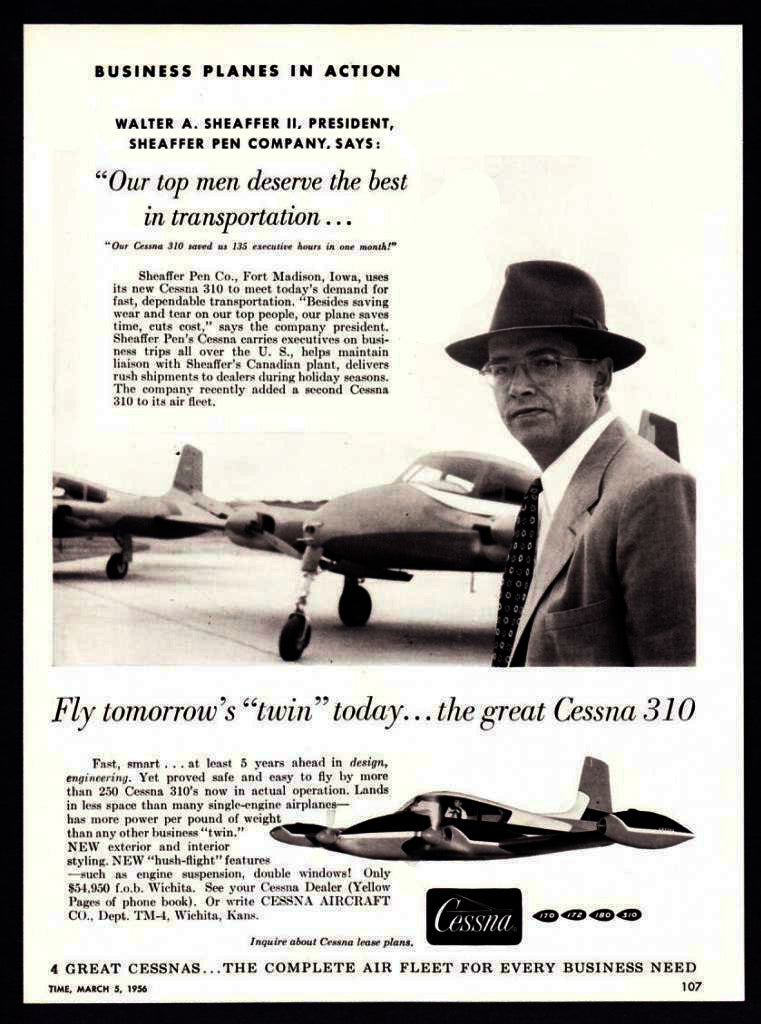
The only photo I could find of Walter II is in this advertisement for Cessna Airplanes.
[caption id="attachment_4800" align="alignnone" width="761"] Walter Sheaffer II Cessna Advertisement. Source: Time Magazine, March 5,1956[/caption]
 Walter Sheaffer II Cessna Advertisement. Source: Time Magazine, March 5,1956[/caption]
The post war dynamics, with airplane travel opening up new overseas markets, led Walter II to establish manufacturing plants in Brazil and Argentina to better address growing emerging markets. Management functions were redesigned to keep up with new manufacturing and office technologies, especially with the increased use of computers.
[caption id="attachment_4804" align="aligncenter" width="1024"] Flags of many nations decorated the entrance to the new plant when representatives from across the world came to Fort Madison for an export convention in 1956. The Fifties were a decade of international growth for the company. Source: Sheaffer Review[/caption]
 Flags of many nations decorated the entrance to the new plant when representatives from across the world came to Fort Madison for an export convention in 1956. The Fifties were a decade of international growth for the company. Source: Sheaffer Review[/caption]
During the 1950’s Sheaffer launched the Snorkel, Lady Sheaffer and PFM (Pen for Men), both very successful. Distribution was set up in Asia, Africa, Europe, Latin America and Australia. Sheaffer was now certainly global.
The End in Sight
Unfortunately, the ballpoint pen was steadily chipping away at the fountain pen industry. New companies entering both the fountain pen and ball pen business had scant regard to quality and were offering unbranded products who’s only USP was low price-points. By the mid-1950's there were over 200 pen companies, as compared to the 50 in business a few years earlier. Individually they were insignificant, but together, they were a serious threat to the organised industry, and Sheaffer had every reason to be concerned.
From the mid-1950's into the 1960's Sheaffer fought hard to compete, but sales kept declining. Sheaffer gradually moved out the lower ends of the market, concentrating on the higher end. In 1965 they eliminated the employee profit sharing program. On March 1, 1966 the inevitable happened; Sheaffer was sold to Textron. Many believe the "straw which broke their back" was the development of the disposable ballpen.
I'll leave the more recent March 1966 to present Sheaffer history for another time.
Sheaffer Pens as Collectibles
As a collectible, Sheaffer pens are still part of the "Big Four" and while have always been popular, are now gaining in popularity due to their quality, relatively low cost and the myriad of different models and colors produced. We usually have a wonderful assortment available in our on-line Catalogs.



Leave a comment
This site is protected by hCaptcha and the hCaptcha Privacy Policy and Terms of Service apply.